

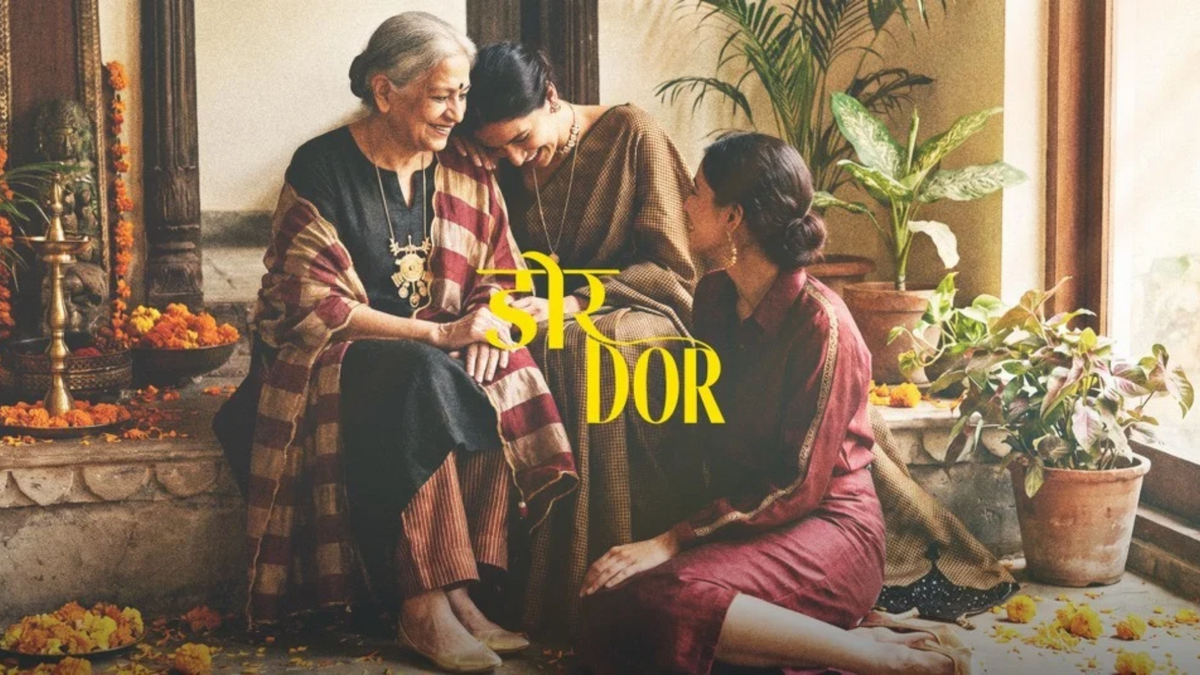
What to Wear for Diwali When You're the One Hosting It
Diwali 2026 falls on Sunday 8 November. Dhanteras is Friday 6 November, Bhai Dooj is Tuesday 10 November, and between them sits the part nobody photographs: the extra plates counted twice, the chair brought down from the loft, the second trip to the market because the first one forgot the wicks. If you are the one hosting, you are not dressing for one evening. You are dressing for five days of work, with one evening in the middle when everyone arrives.
This is a guide to Diwali outfits for that woman. Every piece in it comes from डोर | DOR, our festive collection, and every piece in DOR is cut from pure Chanderi.
The short answer
- Dhanteras, Friday 6 November: gold worn as cloth, not as jewellery. A tissue Chanderi saree or a gold-stripe dress.
- The day before Diwali: a co-ord set. Two pieces, gold only where it counts, and a cut you can climb a ladder in.
- Diwali night, Sunday 8 November: a three-piece Chanderi kurta set or a saree in charcoal, emerald or deep maroon. These are the colours that keep their detail by diya light.
- Bhai Dooj and the lunches after: separates. The kurta on its own, over trousers you already own.
Why Chanderi, for the woman hosting
Chanderi is two threads held in one cloth that never become one thing: a silk warp and a cotton weft, from the pit looms of Chanderi in Madhya Pradesh's Ashoknagar district, protected by a GI tag. The silk keeps its natural sericin because it is never degummed, and that is where the sheen and the famous transparency come from. We have written about how Chanderi is made, and what it should cost in more detail.
Here is what that means on 8 November. It weighs almost nothing, so you can be at the stove at six and still be in it at midnight. It holds a pleat, so a saree draped before puja still looks draped when the last car leaves. And it carries gold well: zari set into the cloth on the loom, or sequin and moti added by hand afterwards, without the fabric going stiff. Most festive wear at this price is georgette, organza or satin, which is why so much of it looks the same in photographs.
Dhanteras, Friday 6 November: gold, as cloth
Dhanteras is the day for buying gold. The Zeena Tissue Chanderi Saree in gold (₹12,800, or ₹13,800 with blouse fabric) lets you wear some. The black warp crosses gold in a check so fine that the whole length reads as one colour, and only turns into a grid when someone is standing next to you. The ornament sits at one end: a scalloped black pallu, hand embroidered in sequins. That weight is doing a job, because it is what makes the pallu fall straight.
If the evening is the jeweller, the market and dinner, the Sitara Chanderi Dress in gold (₹6,400) goes to all three. It is floor-length in a fine gold-and-black stripe, mitred at the bodice so the stripe meets in a V, and panelled through the skirt so it turns at every seam. There is no embroidery on it. The cutting is the ornament.
For gold held back to one band, the Goonj Chanderi Saree (₹11,500, or ₹12,500 with blouse fabric) splits ivory and charcoal with a broad gold check at the waist. Sequin is scattered across the pallu.

The day before Diwali: the co-ord set
Every host knows this day. Rangoli at seven. The lights go up on whichever wall they went on last year. The sweets get collected, and the cleaning that was meant to be finished on Wednesday is not. You need clothes you can move in that still count as dressed when the bell goes at four.
The Laakh Chanderi Co-ord Set in charcoal and gold (₹8,600) is a festive set that isn't a kurta set. The shirt is a proper shirt, with a collar, a full placket and buttoned cuffs, and gold sequin and moti hand embroidery scattered from the shoulders across the yoke. Underneath are high-rise palazzos with a gold zari check, front pleats and side pockets. You will want the pockets by noon.
The Peher Chanderi Co-ord Set in deep maroon (₹7,700) is a generous shirt over an ankle-length skirt, both cut from the same cloth so the line runs unbroken from collar to hem. A narrow band of zari, moti and sequin hand embroidery follows the sleeve seams and the skirt slit. The skirt is lined in cotton and a cotton slip comes with it, so there is nothing to find or pin. A peher is three hours, the old way of cutting the day into eight watches. This set is built to last four of them.
The Dehri Tissue Chanderi Co-ord Set in emerald (₹8,500) pairs a sleeveless wrap top, tied at the side with hand-beaded ties, with a tissue Chanderi palazzo in a gold check. Because it wraps, the fit is set by you rather than by a size label, which helps on a day that ends with a full dinner.
The lightest piece in the collection, and the easiest way in, is the Ujla Chanderi Co-ord Set in ivory (₹6,200). It is a sleeveless A-line top and straight pants, with zari and moti hand embroidery only at the hems, so the gold moves half a beat behind you.

Diwali night, Sunday 8 November: the three-piece
Lakshmi puja, then the doorbell. Of the whole week, this is the outfit that gets photographed, and the one you will wear for six hours, mostly on your feet.
The Kajal Chanderi Kurta Set in charcoal and gold (₹12,500) puts all its work into the neckline. A scalloped arc of gold sequin and moti hand embroidery, finished with drop motifs, is drawn onto the cloth like a necklace, which is one less thing to look for at 6:40 in the evening. It comes with gold-check pants and a sheer organza dupatta striped in gold tissue.
The Syahi Chanderi Kurta Set in charcoal and maroon (₹12,500) is cut on one long diagonal. The hem drops to a point at each side, with two leaf-shaped panels of gold hand embroidery rising from the slits and bands of it at the cuffs. It comes with maroon striped pants and a striped organza dupatta.
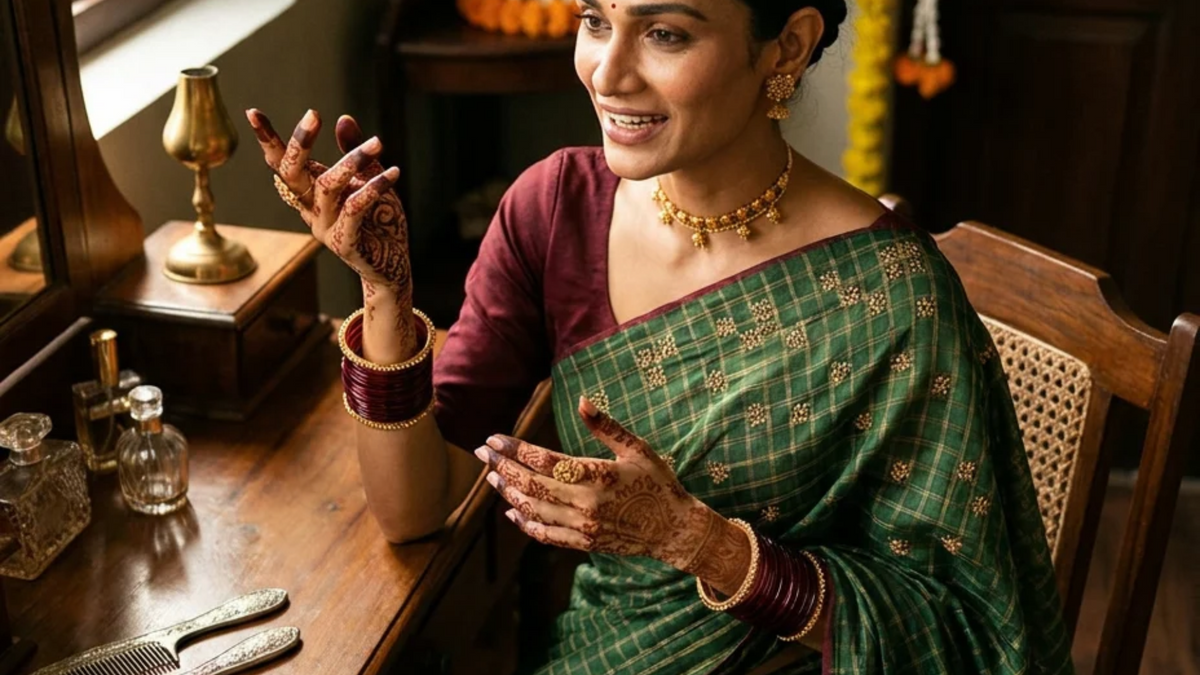
The Abhya Chanderi Kurta Set in maroon and green (₹10,400) keeps its gold to a single line, with sequin and moti hand embroidery running the full placket and returning at the neckline and both slits. The dupatta is green, striped in gold and finished with a scalloped edge. Abhya means without fear, from the raised open palm in Indian sculpture.
Ivory, at a party where you are also the one serving, takes some nerve. The Sadhna Chanderi Kurta Set (₹11,600) has a fine zari check in the cloth that catches light only when you turn, and dense gold hand embroidery at the V-neck and sleeves.
If the evening wants a saree, there are two. The Gulaab Chanderi Saree in deep maroon (₹9,100, or ₹10,100 with blouse fabric) keeps its gold at the edges, in a fine zari stripe along both borders and the pallu end, with sequin scattered across the body as if something gold had been shaken over it. The Siddhi Tissue Chanderi Saree in emerald (₹12,100, or ₹13,100 with blouse fabric) is checked in gold zari, has hand-filled checks along the pallu and border, and is piped in maroon.

Bhai Dooj, Tuesday 10 November, and the lunches after
By Tuesday the house is half empty and the lunches begin: his side, your side, and the neighbours who didn't make it on Sunday. This is where the collection keeps working. Every DOR set is also sold as separate pieces, and the pieces add up to what the set costs.
| Set | Pieces, bought separately | Set price |
|---|---|---|
| Kajal | Kurta ₹3,600 + tissue Chanderi pant ₹4,900 + tissue organza dupatta ₹4,000 = ₹12,500 | ₹12,500 |
| Abhya | Kurta ₹4,300 + pant ₹2,400 + tissue Chanderi dupatta ₹3,700 = ₹10,400 | ₹10,400 |
| Laakh | Shirt ₹3,600 + gold pant ₹5,000 = ₹8,600 | ₹8,600 |
| Peher | Shirt ₹3,600 + skirt ₹4,100 = ₹7,700 | ₹7,700 |
| Ujla | Top ₹2,700 + pant ₹3,500 = ₹6,200 | ₹6,200 |
So you can buy the whole set, or just the piece you will wear most. The Kajal kurta on its own over dark denim works for Tuesday lunch. The Laakh shirt goes to work in November over black trousers, and nobody will know it went to a puja first. The Bela Chanderi Dress in charcoal (₹4,700) needs no styling: an emerald gold-check yoke outlined in hand embroidery, deep maroon turned-back cuffs, and earrings, nothing more.
Why charcoal, emerald and maroon, and not red
Red and gold has become the default of mass festive wear. DOR works in charcoal, emerald, deep maroon and ivory, with gold used as metal rather than a wash. Charcoal holds embroidery detail in low light, where black flattens into a silhouette. Emerald sits next to marigold garlands without fighting them. Maroon is the red that still looks right in photographs the next morning, and it is the colour to wear for Karva Chauth on 29 October if you want one piece to do two festivals.
Ordering for Diwali: the dates that matter
Every DOR piece is made to order. Each product page states its dispatch window, either 5–7 or 7–14 working days, and that line is the one to go by.
- In India, 7–14 day pieces: order by Monday 5 October for delivery before Dhanteras.
- In India, 5–7 day pieces: order by Monday 19 October.
- Outside India: allow four to six weeks door to door. For Diwali, that means ordering by Sunday 27 September.
- Sarees are free size, and you can buy them with or without blouse fabric. If you are taking the fabric, give your tailor a week.
Sizing is on the size chart, and exchanges and delivery are covered on our shipping and exchange page.
Diwali outfits: questions we get asked
When is Diwali in 2026?
Diwali, with Lakshmi puja, is on Sunday 8 November 2026. Dhanteras is Friday 6 November and Bhai Dooj is Tuesday 10 November.
What colours should I wear for Diwali?
Colours that hold their detail in lamplight: charcoal, emerald, deep maroon and ivory, with gold kept to the embroidery or the border. They photograph better than head-to-toe red and gold, and they carry on into winter.
Is Chanderi a good fabric for Diwali?
For a host, it is the best there is. Chanderi is light enough to wear for a long evening on your feet, holds a saree pleat, and carries zari and hand embroidery without going stiff.
What should I wear to host a Diwali party?
Something that looks finished at the door but lets you move in the kitchen. A three-piece Chanderi kurta set with its embroidery at the neckline, like the Kajal, means no heavy jewellery to manage. A Chanderi co-ord set like the Laakh gives you pockets and a cut you can move in.
Can I buy a DOR kurta without the full set?
Yes. Every DOR set is also sold as separate pieces, and the pieces add up to the price of the set.
When should I order for Diwali delivery outside India?
Allow four to six weeks door to door. For Diwali on 8 November 2026, order by 27 September.
The festival is the evening everyone photographs. The week around it is where you actually live, so dress for the week. See all of the डोर | DOR festive collection here. If you are planning Navratri first, our guide to Navratri 2026, its colours and what to actually wear covers 11 to 20 October.


Leave a comment
This site is protected by hCaptcha and the hCaptcha Privacy Policy and Terms of Service apply.